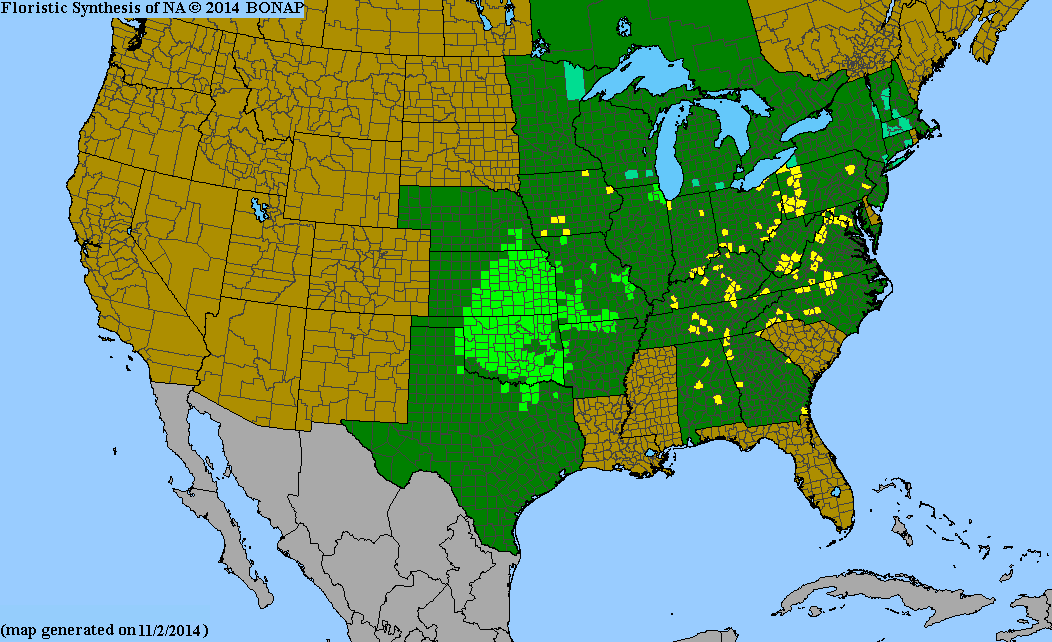
While some plants are limited in range, Baptisia australis is a workhorse in the garden, ranging in sites of open prairie to woodland edge. Growing 3-4’ tall and spreading 3-4’ wide, it is a large multi-stemmed member of the pea family. The glaucous leaves are a grey green-blue and the flower spikes range in color of white to deep indigo, most often occurring as a lighter blue. There is some variability of this plant as it comes from seed. Performing best in full sun, it can be placed in part-shade with additional staking required. It is no wonder this plant was named The Perennial Plant Association's 2010 Perennial Plant of the Year™.
With its deep taproots, Baptisia australis adapts to a wide variety of environments but is found mostly along wood edges, limestone glades, and in prairies. It prefers full sun and moist soils, including clay and limestone, but there are examples of this plant found way out in the Texas Hill Country displaying its survival in drier conditions.
The sweet, soft foliage of Baptisia and its presence makes it a go-to in our full sun gardens, showing a long season of interest from spring and summer with its indigo-blue spikes of blooms to summer with its blue-green foliage to late summer and fall, where the seedpods are held erect over the plant and provide winter structure in the garden. The seed pods are used in cut flower arrangements or in dried arrangements. Wild indigo takes three years to fully establish but afterwards, is easy care. It is well-loved by pollinators, including bees, and is a host for hoary edged and elfin winged butterflies as well as black spotted prominent moth. We’ve found the plant to thrive in anything from a gravel garden to a perennial border to a naturalized setting.